

For the longest time, I only read non-fiction. I liked how efficient it felt. Clear lessons. Clear steps. Clear answers. It made me feel like I was doing life “right.”
I used to think fiction was a waste of time. Why spend my energy reading about “fake stuff”?
Boy, I was so wrong.
I should have started reading fiction much earlier.

Through the characters and their stories, I experienced lives, minds, and emotions far beyond my own imagination.
It reminded me there are many ways to be a person, to think, to feel, to live.
It made me question the perspectives I had accepted by default. Are they really the only way to look at things?
Reading fiction feels like holding up a mirror. What you see in it depends on who you are and where you are in life.
There’s no single right answer. No preaching. Just space to reflect, and to slowly learn how to see for yourself.
Monday, December 22, 2025

I have been trying to keep three books on rotation lately just to add a little more variety to my day-to-day. It’s my first time doing this because, usually, I'm that person who needs to finish one book before even thinking about starting another. But ever since I heard this suggestion from a YouTuber (either Kalyn Nicholson or Jenn Im—I can’t remember which), I thought I’d give it a go.
Right now, my reading list is pretty diverse. I have 3 books on rotation - a Chinese fantasy novel, The Art of Sun Tzu (ngl, this gets kinda dry at times and it's lengthy), and I just finished The Comfort Book by Matt Haig.
That last one felt like a gentle hug in the form of words. Haig's reflections are simple but powerful reminders of resilience, compassion, and taking life moment by moment. So, I thought I’d share a few of my favourite quotes from The Comfort Book with you all, hoping they bring a bit of light and peace to your day.

♠ Things weren’t always one thing or another thing. They were sometimes both.
♠ We are more than can be measured. We are life itself. We aren’t the narrow band of feelings in a single moment. We are the vessel that could contain any feeling. We are the subject in the sentence. We are more than the sum of our achievements. We are more than the feelings we witness. We are the infinity that remains when you subtract them.
♠ Stay for the person you will become.
♠ When we can’t speak, we can write. When we can’t write, we can read. When we can’t read, we can listen. Words are seeds. Language is a way back to life.
♠ It’s easy to be surrounded so entirely by a single view that almost anyone without that view becomes alien. But. We can look at the world through more than one lens. If we look at people through the lens of emotion, at the feelings that drive opinions, rather than the opinions themselves.
♠ The most powerful moment in life is when you decide not to be scared anymore.
Thursday, November 14, 2024

I wasn’t ready for it to be a book on psychology.
This book, written by a Korean woman named Baek Hee, explores her struggles through life, caught in a cycle of ups, downs, and mood swings. At some point, she finally decides enough is enough and plucks up the courage to take herself off to therapy. The book consists of a series of chapters, with lengthy dialogues between the writer and her therapist.
While looking through Goodreads for reviews of this book, I saw many people complaining about it being harsh and mean towards people with mental health issues, and how many issues were glossed over lightly.
I agree, but I also disagree.
I think this book is not something you read to relax or just for some light, comforting “chicken soup” for the soul. You won’t grasp its essence unless you take the time to dive deep into the conversations between Baek Hee and her therapist, while applying the lessons to your own life, stories, and experiences. It’s a book of self-reflection rather than one you read solely from a third-person point of view. Here are the useful points I picked out from the book, which made me start being aware of how I was looking at and analyzing certain circumstances.
I personally think this is the whole reason for reading a book. There are no badly written books or poorly told stories, to be honest – only less effective methods of conveying a message or crafting a narrative. There is a lesson in everything, including a so-called bad book or bad story.
Try viewing this book as a set of suggestions, rather than a do-it-this-way-or-you-will-be-forever-depressed guide. It calls for building the practice of mindfulness.

♠ When you’re having a hard time, it’s natural to feel like you’re having the hardest time in the world. And it’s not selfish to feel that way.
♠ Your perception of reality is so polarised and extreme. you’re only able to see within the framework of ‘Everything about us is the same’ or ‘Everything about us is different.’
♠ You should try to stop yourself from reflexively falling back on thinking patterns you normally default to.
♠ I don’t think it’s a problem that needs fixing. It’s all a matter of how you see yourself.
♠ You’ve got to stop falling into the binary trap of thinking you’re either all-ordinary or all-special. ‘Good’ and ‘bad’ are not the only ways we think in black and white.
♠ Your emptiness and fear are all mixed up, and you’re asking for help to defend yourself. But if you depend on another person for help, it’ll satisfy you only for a moment, and you may not be able to stand on your own two feet later.
♠ Do you think every behaviour falls into a category of, ‘They did this because they hate me’ or ‘They did this because they like me’? The whole point of not liking your friend’s behaviour means you don’t like her behaviour, not your friend as a person. But right now, you keep interpreting every behaviour exhibited by your friend as rejection. Your mind immediately goes to the most extreme explanation instead of stopping to think of the many other reasons your friend could be doing what she’s doing. You keep applying these extreme standards to others. In effect, it’s your own thoughts that are torturing you. Learn to differentiate the parts from the whole. Just because you like one thing about a person, you don’t need to like everything about them. And just because you don’t like one thing about a person, it doesn’t mean the person as a whole isn’t worth your time. I think you should get in the habit of thinking differently.
♠ Love comes in different shapes, and I shouldn’t judge someone else’s love by my own standards.
♠ Many people think they’re the foremost authority on themselves, but you should be more sceptical. You’ve got to ask yourself, ‘Do I really know myself well?’
♠ Your very real problem is that you bring this same judgmental attitude on yourself.
♠ No one was looking down on me except myself.
♠ I feel like I talk about the same problem every time. And you always give me the same answers. I don’t change myself, which is why the same problems keep coming up.
♠ Your perspective of yourself is so narrow and self-critical that you’re unable to see things from a wider perspective, and so you goad yourself into choosing just one angle, which is the easiest way out.
♠ I hope you will listen to a certain overlooked and different voice within you. Because the human heart, even when it wants to die, quite often wants at the same time to eat some tteokbokki, too.
♠ Meeting someone who moves your heart, writing something until it moves the hearts of others, listening to music and watching movies that depict love–I want to always be motivated by love. If pure rationality keeps forcing itself into the spaces in between, I shall lose the shine and comfort of my life–which is why I want to be an emotionally bright person, even if it means becoming impoverished in terms of rationality. I want to hold hands and march with those who feel similarly to me.
♠ I often look for books that are like medicine, that fit my situation and my thoughts, and I read them over and over again until the pages are tattered, underlining everything, and still the book will have something to give me. Books never tire of me. And in time they present a solution, quietly waiting until I am fully healed. That’s one of the nicest things about books.
Saturday, August 3, 2024


Bauman dives into how consumerism has overshadowed the old-school work ethic, with his historical and philosophical take on it. This book is not an easy read because it can feel a bit dry and like you're reading someone’s lengthy thesis.
Bauman begins by discussing how the work ethic became significant during industrialization. In the past, people valued their "workmanship" and preferred leisure over unnecessary labour. But industrial times demanded a different attitude. Factory owners wanted to make workers dependent on them, and with a little help from the government, they pushed for a complete societal shift. Artisans were left out in the cold as factory work became the new norm.
Fast forward to today, and we've shifted from a society of producers to a society of consumers. Satisfaction isn't the goal anymore; it's all about the thrill of wanting more, sugar-coated as a motivation to hustle harder. In the past, your class determined your identity, but now, you build it yourself through the choices you make in the marketplace. More choices mean more freedom, right? Well, not exactly. This so-called freedom is just another illusion created by market forces.
Living in a consumer society means we detest having our choices limited, so we gravitate towards deregulation and neoliberalism. Work, devoid of any real joy, loses its value; and come payday, you’d simply spend your hard-earned money on unnecessary expenditures. Does that imply that the time and effort invested in work are all in vain? To fill the jobs nobody wants, we recreate a survival scenario, but this time, there's no noble work ethic to cling to. Instead, the poor are viewed as inadequate consumers. Society no longer feels the need to uplift them but rather blames them for their situation, branding them as an irredeemable "underclass."
Bauman’s empathy for the poor shines through. They're often labelled as lazy, but he shows they're actually victims of a broken system. Work ethics, Bauman argues, were invented to force people into factory jobs and now serve to blame the unemployed for their plight. With globalization, local governments can't do much to help since capital moves freely across borders. Modern society deals with the poor by marginalizing, criminalizing, and segregating them. They're not seen as potential workers anymore but as failures in the consumer game.
One of Bauman’s more optimistic ideas is universal basic income, something C. Offe also talks about. This would shift our focus from employment to basic rights and protections. But even Bauman knows this solution is a bit too optimistic, given the power of global capital.
Reading "Work, Consumerism and the New Poor" is quite a rollercoaster. Bauman sometimes suggests that work ethics were a grand conspiracy, which seems like a stretch without solid proof. Personally, I'd prefer to see it as a collective societal belief disguised as the norm, rather than a brainwashing tactic used by capitalists. Perhaps to some extent it is, but ultimately, it comes down to whether individuals would simply accept and believe in this belief.
Given that this book was written almost 20 years ago, some parts feel dated, but its message still resonates strongly. Consumerism has only sunk its claws deeper into our lives. Consider this: from housing to healthcare to our daily routines, systems are designed to extract every last penny from us. We're essentially primed to compete for the top, leveraging our education and careers, yet often find ourselves ensnared by rising costs. Consequently, our lives become a ceaseless pursuit of better homes, better cars, and so forth. It's a cycle of chasing bigger, better, and higher price tags, often with more debts piled on.
This book makes it clear that our societal structures are choices, even when they feel like inescapable traps. So it comes full circle: when it's all about choices, what are you choosing for yourself? Because nobody is pointing a gun at your head. There is no black or white, good or wrong within this equation. It’s about where one’s personal values lie. Having previously worked in the retail banking industry for two years has definitely taught me a valuable lesson on this— one’s bank accounts and transactions often speak volumes more about them than the words that come out of their mouths.
"Work, Consumerism and the New Poor" peels back the layers of consumer society, exposing the harsh realities beneath. Bauman's insights into consumerism and the marginalization of the poor are still relevant, pushing us to rethink what we value and how we define success. "Work, Consumerism and the New Poor" peels back the layers of consumer society, exposing the harsh realities beneath. Bauman's insights into consumerism and the marginalization of the poor remain relevant, urging us to reconsider what we value and how we define success.
I wouldn’t recommend this book as a must-read for everyone because, as mentioned, getting through the entire book consumed a lot of focused energy from my end due to its lengthy narrations. Unless you are truly interested in the history of economics, I think a practical takeaway I could share with anyone (even those who are not that financially savvy) is to be conscious of why and where you are spending your money. Remember, there is no right or wrong judgment here; it’s all about your choices and how aware you are of your true intentions behind them. Simple and straightforward.
Saturday, June 8, 2024
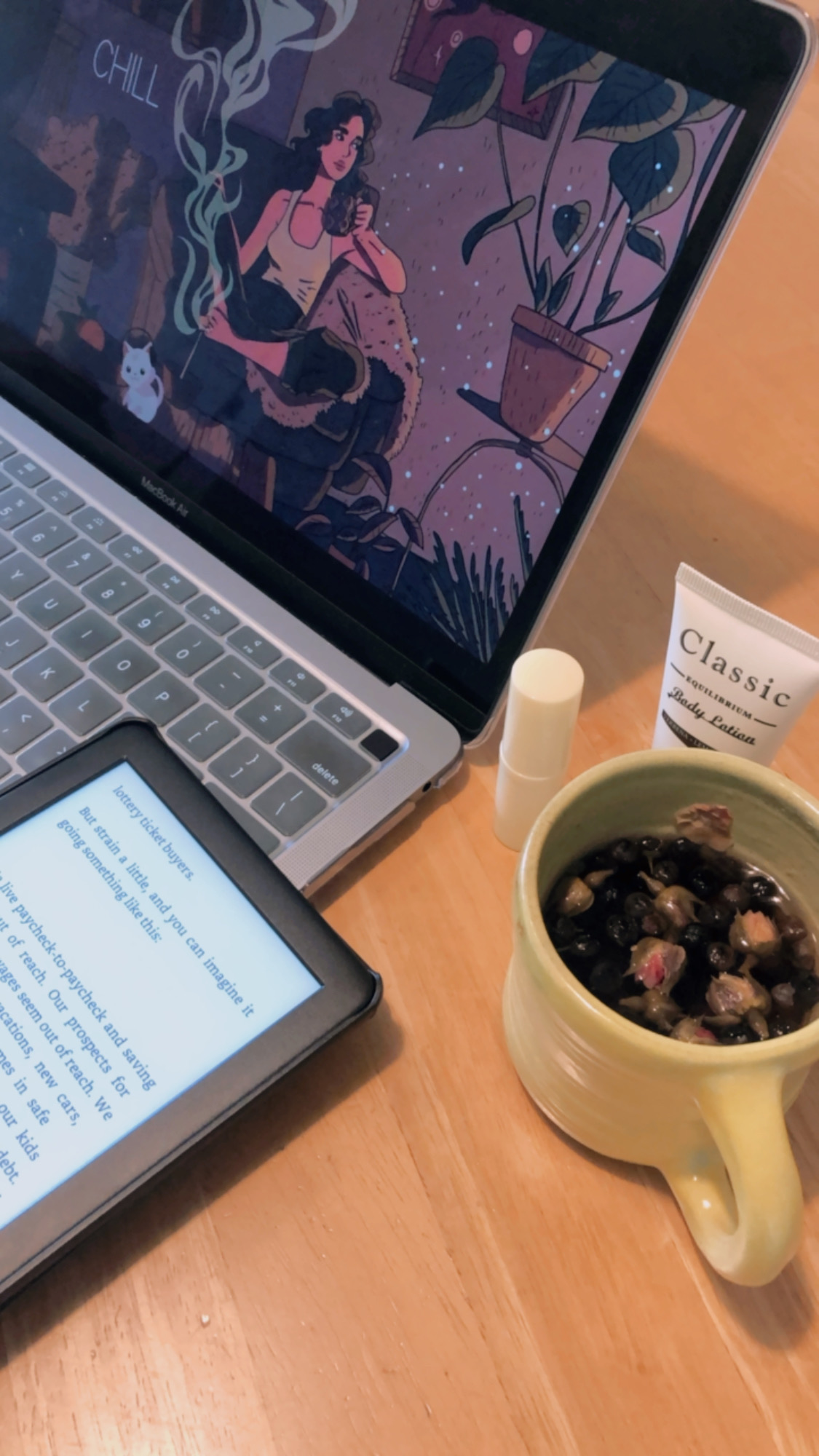
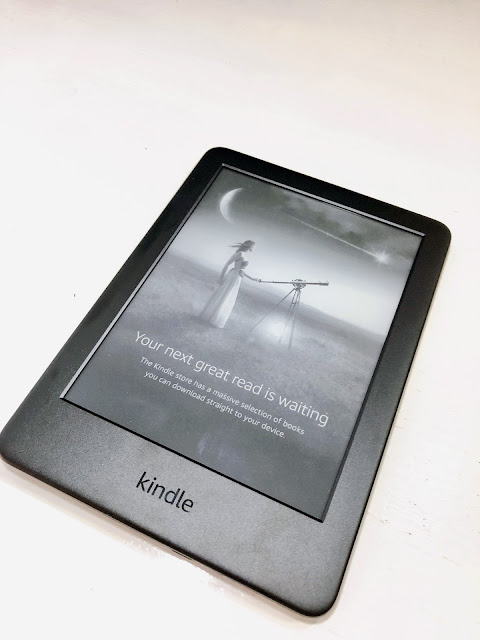
However, reading off my laptop has not been the most convenient approach. It works and I love my Macbook with all my heart, just that (1) I can’t bring my Macbook everywhere with me without feeling the weight (2) the computer screen strains my eyes after reading several pages.
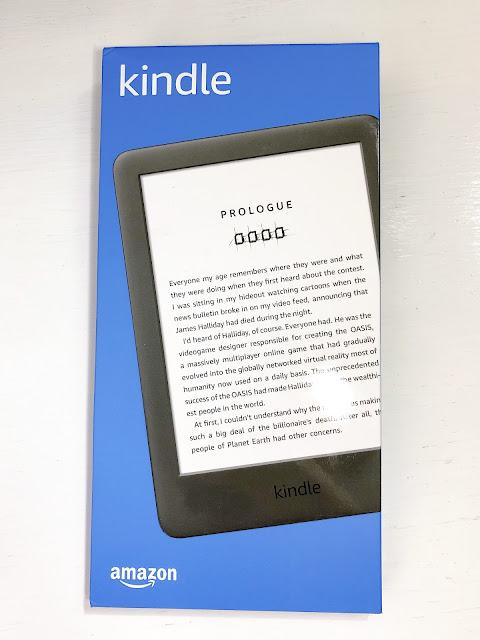
A few Youtubers that I follow (like Jenn Im and Ali Abdaal) constantly rave about their Kindles, but it's such a challenge to find one in Malaysia, physically. I wanted to see and feel it with my own hands before deciding if it's my cup of tea (another side effect of Konmari: I wanted to make sure it will spark joy).
During the Lunar New Year at the start of February this year, my cousin showed up with a Kindle in her handbag. I finally got to try it out - and yes, I liked it right away. So when my mom asked me what I wanted for my birthday, which was on the 12th of February, I asked for a Kindle.

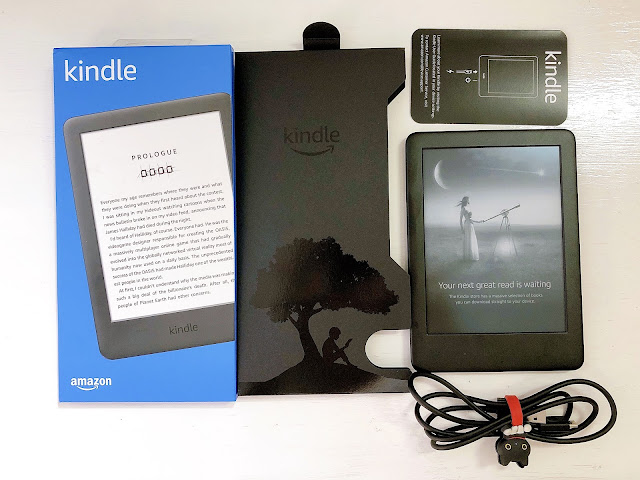
After comparing for a really long time, I eventually bought my Kindle from this seller. I bombarded them with a bunch of questions and they answered me patiently. Also, this seller offers 1 year of warranty at the most competitive price (MYR 359). They shipped out in 2 hours after the payment was completed. The delivery was shockingly fast too - less than 30 hours to arrive in Penang from KL.
* Due to the fact that Amazon doesn't ship to Malaysia, the majority of the sellers in Malaysia import their Kindles from Amazon Japan. The warranties are not provided by Amazon but by the sellers themselves. While browsing the Internet you can see sellers pricing the same model of Kindle at different prices depending on the length of warranty that you are comfortable with.
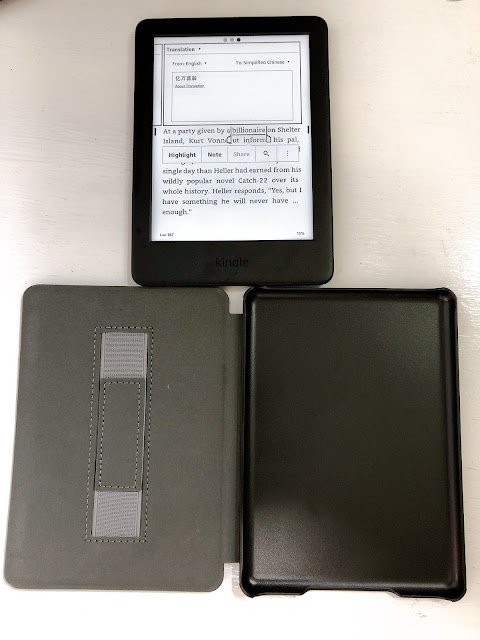
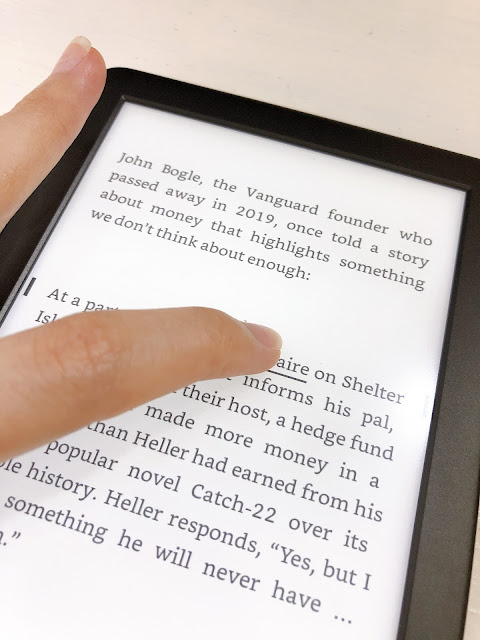
If you’d like to look up a word, just press on it. A toolbox will pop up.


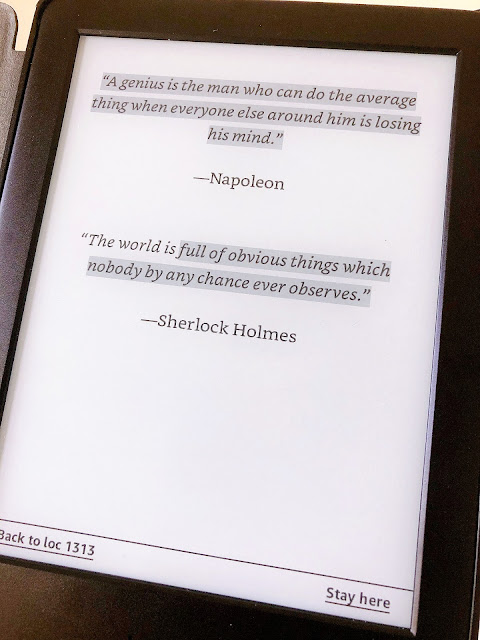
Highlighting only comes in grey on my Kindle due to its e-ink display.

Tuesday, March 22, 2022

♠ Fear means you’re trying to move toward something you love, but your old beliefs, or unhealed experiences, are getting in the way.
♠ Discomfort is what happens when we are on the precipice of change. Unfortunately, we often confuse it for unhappiness and cope with the latter while running from the former. It usually takes a bit of discomfort to break through to a new understanding, to release a limiting belief, to motivate ourselves to create real change.
♠ Nobody wants to believe happiness is a choice, because that puts responsibility in their hands. It’s the same reason people self-pity: to delay action, to make an outcry to the universe, as though the more they state how bad things are, the more likely it is that someone else will change them.
♠ Most common root of discomfort: the space between knowing and doing.
♠ Emotional intelligence is the ability to feel, express, and interpret your feelings productively; self-esteem is believing you’re worthy of loving and being loved despite not being supremely, completely “good” all of the time; happiness is a product of how you cope with your problems and whether or not you see them as the opportunities they are.
♠ The confidence people have in their beliefs is not a measure of the quality of evidence, but of the coherence of the story that the mind has managed to construct.
♠ “What do I want?” is a question you need to ask yourself every day.
♠ We make assumptions based on what our current circumstances “mean” about us, and then also begin to believe that things will always be the way they are—hence why tragedies feel so insurmountable, yet happiness feels so fleeting (in fearing that happiness won’t last forever, we lose it—in fearing that grief will last forever, we create it).
♠ Discomfort is in avoiding the pain, not the pain itself.
♠ Take an honest look at your life and evaluate how much you’ve constructed as a means to avoid pain, and decide whether or not those fears are even valid in the first place
♠ Choose to believe that everything is here to help us.
♠ You’re mentally lazy. You know you should be more present, but you won’t put in the effort to practice it.
♠ Losers wait to feel motivated.
♠ Everything in your life does one of three things: shows you to yourself, heals a part of yourself, or lets you enjoy a part of yourself.
♠ Ask yourself: “If the whole world were blind, how many people would I impress?”
♠ It may not be your fault, but it is still your problem.
♠ Trying to make sense of your life is what’s actually holding you back.
♠ Anxiety is usually bred out of inaction.
♠ What you most dislike in others is, in some variation, true of you: You just haven’t been able to acknowledge it yet. The more angrily and fiercely you respond “no” to that idea, the more intensely you are trying to avoid it. Anger = recognition. You don’t lash back at things you don’t, in some way, regard as being real. So figure out what you most need to heal within yourself by seeing what you most want to change in others. Doing so will free you in a way you can’t imagine. Doing so is a necessary piece of the life-you-want puzzle, because all the energy you’re using trying to avoid, deflect, delude your way into not acknowledging what you need to heal/change/deal is being wasted, at best, and is actually actively keeping you from the life you want, at worst.
♠ Whenever there is a problem in your life, there is a problem with how you are thinking, reacting, or responding.
♠ I decide. My circumstances don’t.
♠ All things are good, because all things serve us in the way of growth and development.
♠ Anything that exists in your life exists because you created it. Anything that persists does so because you are feeding it.
♠ You are not in the world; the world is in you.
♠ Being fearful of moving forward and more fearful of going back—is the only guaranteed way that it will ruin you.